Measuring Success: The Maturity Model for Corporate Alumni Networks
How to move your alumni program from active to genuinely strategic, and where to focus next
Emma Sinclair MBE (CEO), Ian Storrar (Chief Customer Officer), Emma Hayes (Chief of Staff) and Operations Transformation Consultant Rob Dull introduce EnterpriseAlumni’s proprietary Alumni Network Maturity Model – a practical framework for understanding where your program stands, where the gaps are, and what to prioritize next.
Five things we learned about Success: The Maturity Model for Corporate Alumni Networks
“The organizations that move fastest are the ones that start with a really honest picture of where they are today ...”
Emma Sinclair
“Maturity is not about racing to five in every dimension. It is about identifying the outcomes that matter and making progress where the return justifies the investment ...”
Ian Storrar
“The aim is not to score five in every area, but to identify which dimensions matter most ...”
Emma Hayes
“Start small. Find one champion, help them achieve a clear result and share that success …”
Ian Storrar
“The trade-off is between speed and resilience: siloed ownership can accelerate progress, while integrated ownership creates a stronger, more sustainable program …”
Rob Dull
Q&A
What problem was the maturity model designed to solve?
Ian: Customers were struggling to explain how their alumni programs supported wider business priorities. The model helps them communicate that value, capture outcomes such as hires and business introductions, and measure progress. Rather than benchmarking against other organizations, it helps teams assess where they are now, where they want to be in 12 months and how to get there.
Rob: A maturity model also gives sponsors, stakeholders and delivery teams shared goals. It helps them measure value and structure progress from a small working group into a sustainable network of people, processes and tools.
How was the model developed?
Emma H: The model emerged from years of working with organizations of different sizes, industries and levels of maturity. We saw that successful programs shared certain qualities, while struggling programs repeatedly encountered the same barriers. Six dimensions kept surfacing. Together, they show whether a program is delivering value, engaging people and remaining sustainable. It is a living, data-driven framework that will continue to evolve.
How is the model structured?
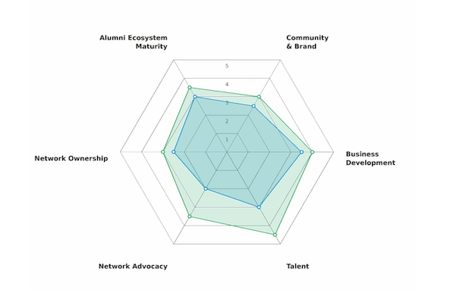
Emma H: The radar chart gives an immediate picture of where a program is strong and where it is still developing. It plots the program’s current state and its aspirations for the next six to 18 months. The gap between them helps shape the strategic conversation. Each dimension is scored from one to five, from informal and reactive approaches to programs embedded in the organization. The aim is not to score five in every area, but to identify which dimensions matter most.
What does quantifying the model offer?
Rob: Agreeing what each dimension means in measurable terms exposes misunderstandings, builds alignment and strengthens commitment before implementation begins. The radar chart also shows how the dimensions relate to one another. Its peaks and gaps reveal strengths and weaknesses across the system, rather than treating each factor in isolation.
What are the six dimensions?
Emma H: They fall into two groups. The three ROI dimensions – business development; talent; and community and brand – are the outcomes for which the business will hold the program accountable. The three foundational dimensions – network advocacy, network ownership and alumni ecosystem – create the conditions for those outcomes.
Network advocacy measures visible, credible senior support. At the highest level, a named sponsor uses the alumni network consistently as evidence of the organization’s culture and long-term relationships.
Network ownership asks who runs the program and whether they have the authority and resources to do so. At the low end, it is an informal, side-of-desk responsibility. At the high end, ownership is embedded in the operating model and is not dependent on one person.
What is the case for a Chief Alumni Officer?
Emma S: BCG is a clear example. Its Chief Alumni Officer has a standing fortnightly slot on the executive committee agenda, giving the program senior ownership and a seat at the table. According to BCG’s CEO, appointing a senior partner transformed its scale and impact. Other organizations have visible senior sponsors, but public support does not always translate into resources, hands-on involvement or influence. That is the gap the model evaluates.
What does the alumni ecosystem dimension measure?
Emma H: It measures the breadth and intentionality of the alumni experience. At the lower end, engagement may be limited to an unofficial LinkedIn group or a spreadsheet managed by one person. At the highest level, it is a coordinated, multichannel ecosystem serving different alumni groups and integrated with the organization’s technology and strategic priorities.
How does A&O Shearman’s Fuse program illustrate this?
Emma S: Fuse goes beyond traditional alumni engagement. It supports legal-tech companies through an integrated innovation ecosystem, with dedicated spaces in London and San Francisco. Alumni contribute by referring founders and helping to select participants. The program demonstrates how an alumni network can support wider business innovation.
What are the ROI dimensions?
Ian: The first is business development. Alumni can generate sales, referrals and stronger client relationships, but many organizations do not yet manage this systematically. Some firms now place their alumni programs within their business development teams.
The second is talent. Boomerang hires and alumni referrals can improve retention, reduce recruitment costs and shorten the time it takes people to become productive. Alumni can also bring experience, intellectual property and strategic opportunities back into the organization.
The third is community and brand. Former employees can become powerful advocates, strengthening customer loyalty, culture and long-term business relationships.
How should organizations bring the dimensions and stakeholders together?
Rob: Programs often begin with individual champions or small teams, which can move quickly because there are fewer dependencies. As the program matures, ownership should expand across the organization, with different teams becoming active co-owners across people, processes and technology. The trade-off is between speed and resilience: siloed ownership can accelerate progress, while integrated ownership creates a stronger, more sustainable program.
How do you avoid involving too many stakeholders too early?
Rob: Someone may support the broad idea but become cautious once they see the practical detail. Introduce stakeholders gradually, give them time to understand the model and involve them in shaping the measures and implementation. People are more likely to become committed participants when they have helped build the approach, rather than simply being asked to approve it.
Can you show how the dimensions work together in practice?
Ian: This anonymised case study shows how the dimensions interact. Pemberton LLP has a long-established alumni program, strong senior sponsorship and a dedicated program manager, with ownership shifting from marketing towards business development.
Its platform, communications and data are strong, but it now needs better alumni segmentation and more systematic use of it’s alumni relationships. Talent is its strongest dimension, with applications, boomerang hires and referrals tracked, while alumni also support the firm’s reputation and future business.
Can you illustrate how the model works in a retail setting?
Emma H: Summertons is a fictitious heritage retailer with 800 stores and up to 90,000 employees. Its alumni program has strong CEO advocacy but weak ownership, with one part-time HR manager and no formal mandate or KPIs.
Its platform is not integrated with HR systems or designed for its mobile-first workforce. There is some potential to drive business through alumni, while talent is a major opportunity: a third of seasonal hires are returning employees, but that data is not used strategically. Alumni also retain strong loyalty to the brand, yet communications are unsegmented and influential advocates are not being identified or activated.
What do the differences between the two scenarios show?
Rob: Pemberton has the infrastructure, data and opportunities, but lacks the commercial activation needed to use them effectively. Summertons has strong advocates, including its CEO and program manager, but weak foundations. Without the systems and structures to turn that support into action, the momentum is lost. In short, Pemberton has infrastructure without activation; Summertons has advocacy without infrastructure.
At what point is an alumni program considered mature?
Ian: Maturity is not about racing to five in every dimension. It is about identifying the outcomes that matter to the organization and making progress where the return justifies the investment. Different dimensions will require different levels of ambition, and progress will not always be linear.
Rob: Focus on the next achievable level rather than defining the final destination in too much detail. The long-term ambition should be clear, but people, processes and technology will change. Incremental goals are more practical and help maintain momentum.
How can organizations push further across the six dimensions?
Ian: Start small. Find one champion, help them achieve a clear result and share that success. Showing how the program helped someone win business, meet targets or strengthen client relationships will encourage others to take part. The program can then grow gradually across teams and offices.
Once you have completed your organization’s radar scoring, what comes next?
Rob: First, verify that everyone understands the scores in the same way. Then identify the priority dimensions and the activities needed to improve them, including who is involved, any obstacles and how success will be measured. Assess effort against value, prioritise the work and build it into a quarterly roadmap.
Ian: The model should support an on-going conversation. It creates a shared understanding of where the program is now, what matters most and what needs to be delivered over the next quarter and year.
How do you move from personal alumni relationships to a program that benefits the whole organization?
Ian: Combine storytelling with data. Turn successful relationships into internal case studies, supported by evidence, to show stakeholders how alumni engagement creates wider organizational value.
What is the best place to start?
Emma S: Take an honest look at your current position across the six dimensions. Identify the data you already have, your organization’s priorities, the stakeholders you need to influence and the returns they expect. Bringing everything together in one view often changes the internal conversation and helps organizations decide where to focus next.
Register to watch

