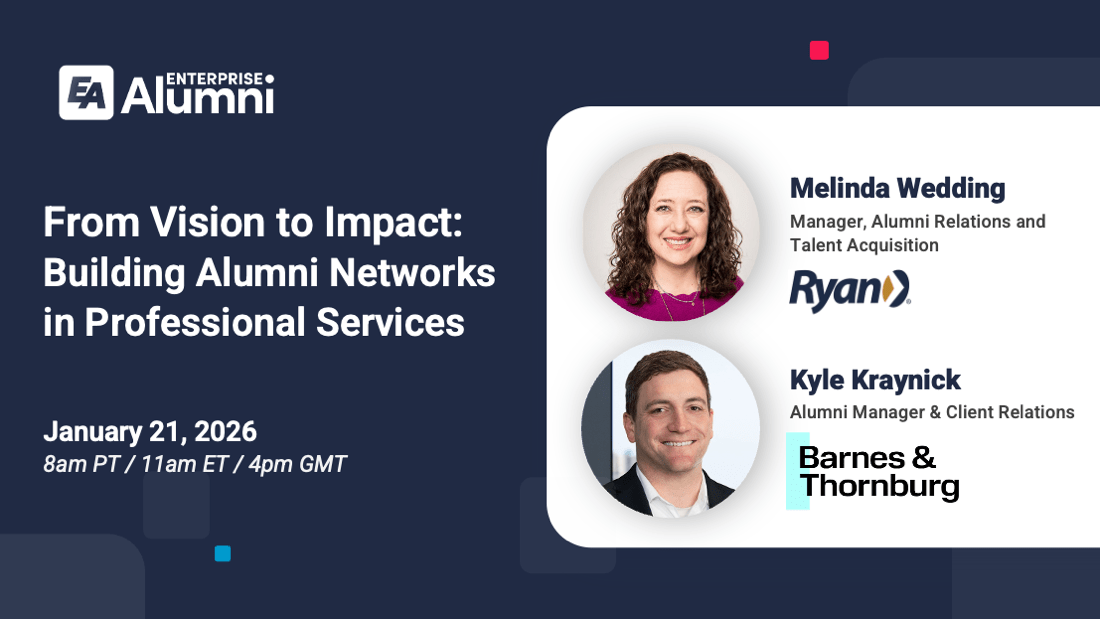
From Vision to Impact: Building Alumni Network ROI in Professional Services
Insights for alumni leaders seeking engagement, credibility and measurable impact across their firm.
Alumni leaders often face the same challenges, from knowing who to include, getting senior support, how to engage your community, and proving progress before the ROI numbers fully catch up. We took a close look at how to move alumni programs off the drawing board and into real impact.
Thank you to our guest speakers:
- Melinda Wedding, Alumni Relations Manager, Ryan
- Kyle Kraynick, Client and Relations Manager, Barnes and Thornburg
Five Thing We Learned About Vision to Impact: Building Alumni Network ROI in Professional Services
- Alumni are forever …
“Just because someone moves on to someplace else doesn't mean they're dead to us …”
Melinda Wedding
- Alumni want to feel included …
“The more that you can create inclusivity, the more likely people are to stay engaged with the firm …”
Kyle Kraynick
- Keeping in contact is human nature …
“People are excited to talk about who they know. People are in a good spirit of: we want to support alumni, keep in touch, and maximize the expertise in our community …”
Melinda Wedding
- Keeping in touch is important with everyone …
“It can be difficult to engage with alumni who go to competitors. But if you disappear from their lives for years, then all of a sudden you’re like: “Hey, best friend, how's it going?”, it might seem a little off. The more you engage, the more it'll strengthen your community …”
Kyle Kraynick
- Alumni want different things …
“Some people want networking at a high level. Others want information. Others are just there to connect with their friends. Finding ways to hit all of those components is important …”
Melinda Wedding
Q&A
How did Ryan’s alumni programme come to sit in HR?
Melinda: I have a background in HR, so I have that HR mind set. We started in 1991 with two employees. Our founder knew that the need for sharp elbows was not necessary. Just because someone moves on to someplace else doesn't mean they're dead to us. That’s the start of the origins of the alumni program. We treat people well, and want to make sure they are equipped to succeed, even if they choose to do something else in the future.
Why is alumni increasingly moving up the agenda
Kyle: Barnes and Thornberg is a full-service law firm, with over 20 offices across the US, and clients worldwide. Part of our growth model is to not only provide outstanding legal work and client service, but to do so in an inclusive environment that fosters strategic growth. Alumni naturally fits into that, because the more that you can create inclusivity, the more likely people are to stay engaged with the firm. We are now expanding our alumni programme to not just focus on attorneys, but other legal talent and professionals.
Where should an alumni program sit inside professional services to maximise talent and culture?
Melinda: I can see why it matters to be people-related. I'm in talent acquisition, so that's how our chain of command goes up to our COO.
Kyle: It depends on what your goals are for your alumni program. If it’s building culture and ensuring you’re hiring the right talent, then alumni should sit in HR or recruiting or legal talent management. If the primary goal is to develop business, then placing alumni within marketing and business development can make more sense.
Which senior champions do you have on board?
Melinda: I have contacts in our client experience team, client services team, and sales and marketing team. Our Director, Andy Taylor, in particular has been a strong mentor and advocate for us.
Kyle: We truly do have top down importance and commitment here at Barnes and Thornberg. Our whole C-Suite are invested in alumni.
What is the impact of revenue when rehiring alumni?
Melinda: We are able to track how many alumni we have, how many rebounds we have, and the impact of those rebounds on revenue, who – at the highest level – were contributing around $30 million in revenue. It made us think: “Can we afford to lose any of these people?” or conversely: “This would be the impact if we brought all these people back.”
Kyle: The first thing I do is to look at our alumni and the revenue they are generating for the firm. Typically, 12-15% of clients have alumni, who produce 40% of our revenue. It’s hard to see if that's directly related to alumni engagement, but theoretically, the more we engage with them, the more those numbers should go up. As you build out your alumni program, you should track your alumni engagement so that you can say: here's the true ROI of engaging with this community.
How do you get colleagues to engage in alumni?
Melinda: The value comes from their relationships, on a personal level, or as a connection that leads to something else. People are excited to talk about who they know. People are in a good spirit of: we want to support alumni, keep in touch, and maximize the expertise in our community.
How do you decide who qualifies as alumni?
Melinda: If you have a gap in your tenure and you're in our system, we flag you as an alum. That's interns all the way up to principals who have returned after 15 years. We have plans for our intern program, to say: “We want to celebrate you,” and set up a group where they can interact. For those further into their careers, we might suggest a community event, like our recent events in Dallas and New York.
Kyle: We’re going to be more inclusive with how we define alumni, and no longer focus just on attorneys, to really engage with people as best and as often as we can.
Are there specific engagement challenges you need to overcome?
Melinda: The hard part is finding out what's important to any given person. Some people want networking at a high level. Others want information. Others are just there to connect with their friends. Finding ways to hit all of those components is important. There can be some territorialism around clients. For alumni who are competitors, it’s more about social events.
Kyle: It can be difficult to engage with alumni who go to competitors. But if you disappear from their lives for years, then all of a sudden you’re like: “Hey, best friend, how's it going?”, it might seem a little off. The more you engage, the more it'll strengthen your community over all.
What do you offer to encourage alumni to sign up?
Melinda: The goal is to say: how do we help transform someone's career in a meaningful way? If they're interested in coming back, where's the right fit, and where is it going to make the most impact? I've had alumni reach out who want to be involved in a totally different area than before. So it's developing some of that knowledge and just saying: this could make sense, but not right now.
How can programs adapt when the perks may resonate less with more senior professionals?
Kyle: You need to figure out what's important to the person. If they care about personal branding, look for opportunities to include them in that. If they care about networking, bring them into events or webinars that feel specific to them. If they want to mentor, connect them with junior alumni to share their experience and their knowledge. It takes time, but tailoring your message is really going to help.
How do you measure success in the first six to 12 months?
Kyle: How we’re going to measure success is by our engagement with the alumni program. Our communications and business intelligence group are putting together the first newsletter of the year, in which we have created an external alumni survey to understand what our alumni care about, with a specific portal for people to sign up for our alumni mailing list. Being able to look at who wants to be involved, and how to tap them in to become an alumni, is really going to help define the program going forwards.
Kyle: Anything that you can point to direct your business generation, through taking alumni to lunch, or bringing them into your office, is really going to help you build more resources behind your alumni program.
Melinda: Our newsletter engagement is wild. Our marketing team says: “Wow, I can't believe you get this many people opening your newsletter.” The value in alumni is relationships, and connecting people in a world that's becoming more automated and influenced by AI. The people that you know and trust are the people that you have worked with. However we automate the world, we're still people, and we're still going to interact with each other at a very personal level.
How do you build a program where alumni don't feel they are currency and revenue?
Melinda: Just being thoughtful, intentional and caring is the core.
Kyle: Try to engage with your alumni in a way that benefits them. Don’t think what your alumni program can do to benefit your firm, but what it can do to benefit your alumni.
What cultural signals does an alumni network send to current employees?
Melinda: The value of an alumni network comes from personal growth. We acknowledge that you're here and that we have a relationship. Sometimes, the next thing in your life path, is going to be different. At the end of the day, if we're really invested in you within our employment contract, then we should be invested in you after that ends.
Kyle: We want to cultivate people's careers no matter where they go. You can build into your firm's narrative from the recruiting, to the onboarding through professional development, and transition to alumni that you are an important part of the community, no matter where you go. We understand that people change jobs all the time. So why not support them in those endeavours, and help them as they continue to develop professionally and transition throughout their career.
Register to watch
