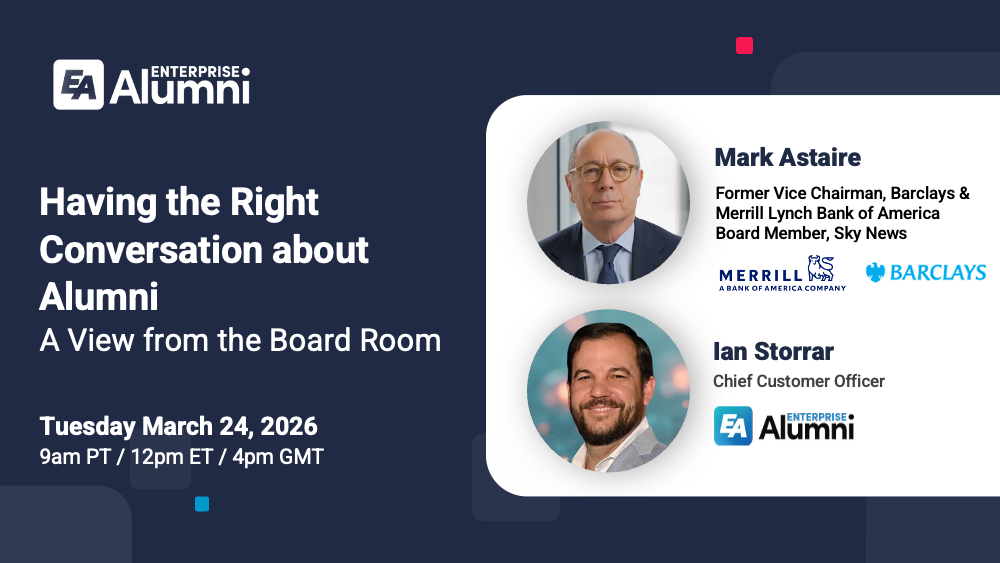
Having the Right Conversation About Alumni: A View from the Boardroom
What it really takes to elevate alumni from a good idea to a board-level priority.
Senior leaders instinctively understand the power of relationships, trust, and shared history, but alumni programs are often still viewed as informal or peripheral initiatives. In this session, we explored how alumni land in the boardroom conversation, what executives actually care about, and how organizations can position alumni as a strategic asset that supports business development, culture, hiring, and long‑term reputation rather than a purely social network.
Thank you to our guest speakers:
Mark Astaire, Former Vice Chairman, Barclays and Merrill Lynch Bank of America, Board Member Sky News
Ian Storrar, Chief Customer Officer, EnterpriseAlumni
Five Things We Learned From: Having the Right Conversation About Alumni: A View From the Boardroom
1. Alumni represent an enormous untapped opportunity
“Not to try and access that good feeling that people have, particularly if they worked there for an extended period of time, is an enormously missed opportunity”
Mark Astaire
2. Organizational Reputation Fuels Alumni Engagement
“The best institutions are very good at reminding you of the essence of that organization, what it has achieved, what its successes are, and why you should feel proud about it. People like to work in places which are successful, that have a good reputation”
Mark Astaire
3. Alumni signal how a company values its people
“We look after our people when they are here and when they have left because we value what they have done. That is a very strong feeling”
Mark Astaire
4. Human relationships matter more as AI accelerates
“People are critical to future business development and hiring plans. You want experienced people who have a network and understand your business. AI cannot do that”
Ian Storrar
5. Start small by putting the right people in the room
“The best way is to persuade senior management to participate in something small. Showing who will be in the room works better than giving them a presentation”
Mark Astaire
Q&A
How has alumni been important in previous high level banking roles?
Mark: The best institutions are very good at reminding you of the essence of that organization, where it is, what it has achieved, what its successes are, and why you should feel proud about it. People like to work in places which are successful, that have a good reputation, and so forth. Working with three banks for roughly ten years each, I feel very positive about that experience, and there is a good natural starting point for any relationship. In business, you want to feel good about the places you are interacting with.
How do you perceive the strategic value of corporate alumni?
Mark: In investment banking, it is a very competitive industry and you are always looking for an edge. In life, you want to deal with people you like, people you trust, and people you know. If you worked together ten or fifteen years ago and had a good experience, that is an edge. Not to try and access that good feeling that people have, particularly if they worked there for an extended period of time, is an enormously missed opportunity. If you meet someone and say you worked at the same bank at the same time, that is an incredibly powerful introduction to any relationship.
What conversations matter most to senior leaders?
Ian: In the corporate world, it is critical to have that bond of trust. When alumni engagement is done simplistically, it becomes transactional. When it is done well, it is a story, and it is a story that includes you and what you are going to do as an active participant in that wider community. Senior leaders care about narrative and alignment. You need to tie what you are talking about to what that executive or business is being measured on.
Mark: When you promote the merits of your company to people who used to work there, you are saying something important. You are saying we look after our people when they are here and when they have left because we value what they have done. That is a very strong feeling. This is not just a party. This is a real business opportunity.
How do you get alumni initiatives onto the C Suite radar?
Mark: The best way is to persuade senior management to participate in something small. Bring people around the table who worked at the firm, make sure they are interesting, high quality people, and use that to pull in senior management. Showing who will be in the room works better than giving them a presentation. Saying come and meet people you used to work with is, in itself, a pull. It can be done on a fairly modest basis.
Ian: Most people in positions of influence intuitively understand the power of alumni because they have their own connections. When former leaders come back, it signals that they matter and that they are still part of what is being built. If you connect alumni engagement to strategic priorities, support becomes much easier.
Where should an alumni program sit within the organization?
Mark: I think the right place is client based marketing. They are good at organizing events and an enjoyable event is critical. The worst thing is when these things are poorly organized. Starting around business generation is easier to understand than starting with boomerang hires. Focus on getting the right people in the room who have the ability to give business.
How do you demonstrate value before full ROI data exists?
Ian: When you are starting out, it is hard to know where the data will come from, particularly for business development ROI. You do not have to boil the ocean. Start with one team, one office, one region, or one line of business. A picture or a story tells a thousand data points sometimes. If you can get other people telling that story, it starts to spread across the organization.
How can alumni teams demonstrate that boomerang hires are a measurable ROI outcome?
Ian: You can never say that one thing was one hundred percent of the driver for a hire, but you can ask people how they came into the process. You can build it into onboarding or the interview workflow. You can track it in your HR software. Start small and get better at it over time.
How should alumni teams work with partners or leaders who are not yet structured about alumni?
Mark: You need to understand what the person you are meeting is trying to achieve. Preparation for internal meetings is as important as external meetings. There is no point talking to someone about something that does not help them. Focus on the people who you know can benefit from it.
How should companies approach unofficial alumni networks?
Mark: People often do not know they are unofficial. If they are inclined to go to something unofficial, they are probably inclined to go to something that is official. Connect with the person arranging it and see if you can make it work for both parties. The issue with informal ones is that they can be very big and include people most attendees would not want to see again. Being bespoke and selective works better.
Should companies have senior advocates or ambassadors for alumni?
Ian: Alumni activity happens organically everywhere. The question is how to engage it and amplify it. There are natural networkers and storytellers who already do this. It does not have to create more administration. Small support can go a very long way. Senior advocates become signal bearers for what you are trying to achieve.
What role does alumni play in an AI driven world?
Ian: People are critical to future business development and hiring plans. You want experienced people who have a network and understand your business. AI cannot do that. Alumni engagement is a core pillar of strategy.
Mark: As things become more automated, being in the same room with people you have an immediate connection with becomes enormously powerful. Human interaction cannot be replicated technologically. Deals still get done because people meet face to face.
Why is alumni technology now essential?
Mark: You want technology to work for you and be easy to use. You want to be able to access people who used to work in the firm and find where they are now.
Ian: The stakes have never been higher. You need technology that allows you to start small, grow, and integrate critical processes. Having something built for purpose gives you the foundation to keep going and to respond to what comes next.

